

A perspective on why motivated learners still struggle, and what stronger Revit learning should build instead Part 2.
People can be motivated, disciplined, and genuinely willing to improve… and still struggle to build real confidence.
Not always because they are incapable.
Not always because they are not trying hard enough.
But often because the learning sequence itself is weak.

Scattered learning may create exposure, but connected learning builds understanding.
They are shown commands before relationships.
Tools before model behavior.
Features before workflow logic.

When tools are taught before relationships, learners may memorize actions without understanding project logic.
And when that happens, progress can look real on the surface while confidence underneath is still fragile.
That kind of learning may feel productive at first.
But over time, the gaps begin to show.
They show up in hesitation.
In inconsistent modeling.
In slower troubleshooting.
In documentation problems.
In coordination issues that should have been easier to anticipate.
So the next question becomes:
If the learning sequence is weak, what should the first step actually look like?
In my view, it should not be more overload.
It should not be another wave of scattered tips, disconnected tutorials, or isolated feature demonstrations.
It should begin with something more fundamental:
CLARITY
Clarity about what Revit learning is supposed to build.
Clarity about how project logic connects decisions.
Clarity about why workflow understanding matters just as much as software exposure.
Clarity about the difference between repeating actions and developing judgment.
Because before someone learns Revit deeply, it helps to understand why so many learning experiences fail in the first place.
And before they invest more time, energy, or money, it helps to see the difference between learning that produces repetition and learning that produces real transferability.
A better first step should help learners understand that Revit is not just a collection of tools.
It is a system of connected decisions.
A wall is not just a wall.
A view is not just a view.
A family is not just a component.
A model change rarely stays isolated.
Everything begins to affect something else.
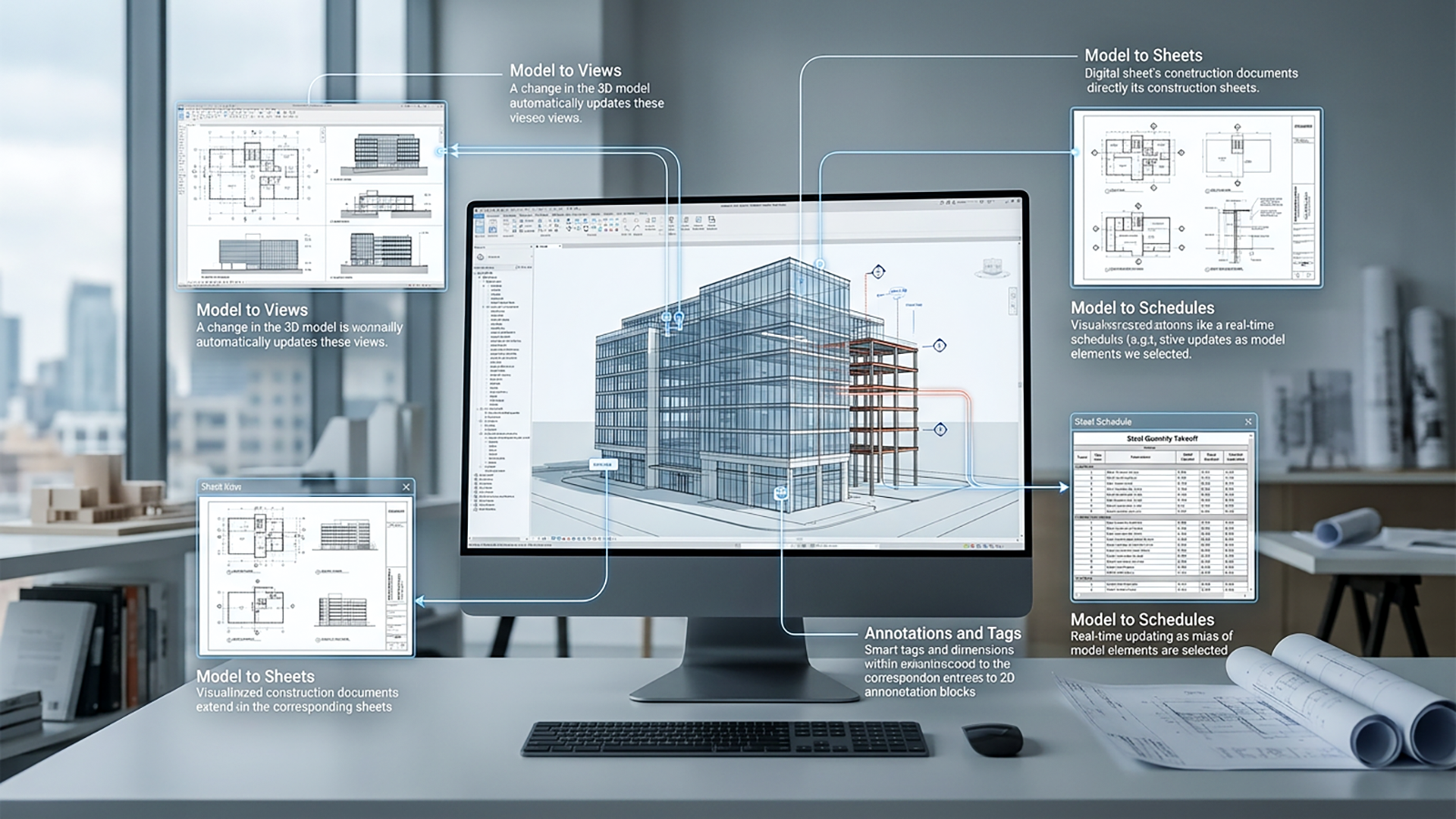
In Revit, decisions rarely stay isolated. Stronger learning helps people see what each choice affects downstream.
And that is exactly why weak learning sequences create so much confusion later.
They may teach people how to do something.
But they do not always help them understand what that action influences, why it matters, or how it connects to the larger project workflow.
That is where a stronger beginning matters.
Not necessarily a bigger course at the start.
Not necessarily more content.
But a clearer foundation.
A first step that helps learners see:
Why workflow matters
Why sequence matters
Why model behavior matters
Why early decisions affect downstream results
Why confidence in Revit is built through connected understanding, not just repeated exposure
That idea is a big part of why I created the Revit Clarity Starter paths.
They are not meant to replace a full formal Revit course.
They are meant to help learners, professionals, and teams begin with more clarity about what stronger Revit learning should actually look like if the goal is better judgment, more consistent project results, and a more reliable path forward.
Each path speaks to a different role, but all of them respond to the same core issue:
Too many learners are exposed to Revit in ways that look like progress, but do not build enough understanding underneath.
For Architecture, that may mean understanding how Revit thinking supports design workflow, project setup, and clearer documentation.
For Structure, it may mean stronger clarity around discipline logic, dependable setup, and better coordination through more structured modeling.
For MEP, it may mean understanding why sequence, system relationships, and change awareness matter so much in highly interconnected project environments.
For BIM Management, it may mean seeing more clearly why workflow-centered Revit learning affects not only individual performance, but also team consistency and delivery quality.

The best first step is not more overload. It is more clarity about how learning should actually work.
In all cases, the starting point is the same:
Not more noise.
Not more confusion.
Not more disconnected information.
But more clarity.
Because in Revit, clarity is often where stronger learning really begins.
