

A perspective on why motivated learners still struggle, and what stronger Revit learning should build instead Part 1.
One of the most overlooked problems in Revit learning is this:
People can be motivated, disciplined, and fully willing to learn, and still struggle to build real confidence.
That should tell us something important.
Many learners attend training. They watch tutorials. They follow steps carefully. They put in effort. Yet when a project condition changes, a workflow breaks, or a task requires judgment instead of imitation, uncertainty often returns very quickly.
That is one of the reasons Revit training still fails more often than it should.
Not because learners do not care.
Not because they are incapable.
But because the learning path itself is often weak.

Following a narrow, brightly lit tutorial path is comforting, but it fails the moment a real project condition changes. The person represents the user who is trapped, facing uncertainty when the step-by-step guidance abruptly ends and the chaotic reality of a real project takes over.
When progress looks real, but the foundation is still fragile
This is a pattern I have seen many times.
A learner can reproduce what was shown during a lesson. They can repeat the process. They can complete the exercise.
But when they need to apply that same knowledge independently in a new situation, the confidence is often not there.
That is a very important distinction.
Following steps is not the same as understanding the logic behind them. Recognizing a command is not the same as knowing when and why to use it. Repeating a workflow is not the same as being able to adapt it.
On the surface, it can look like progress.
Underneath, the foundation may still be fragile.
The problem is often not motivation. It is sequence.
In many cases, Revit is taught in a way that places software actions before conceptual understanding.
Learners are shown tools before they understand model behavior. Commands before relationships. Features before workflow logic.
So they may remember where something is in the interface. They may remember a sequence of clicks. But they still may not understand what the model is doing, what should happen next, or how one decision affects another.
That is often where confidence begins to break.
Because when understanding is weak, even a motivated learner can start to doubt themselves.
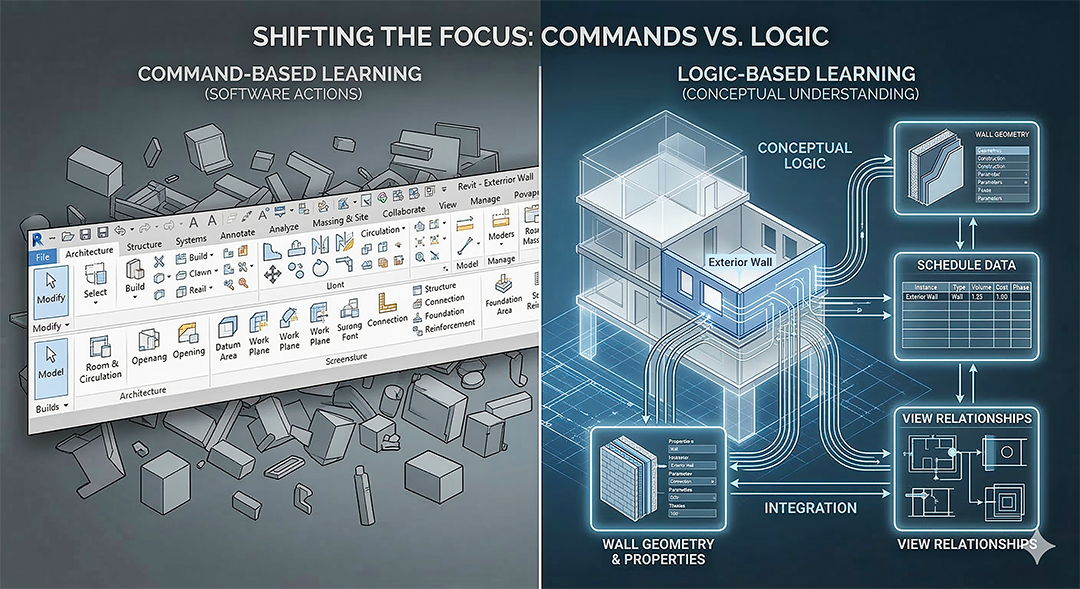
This comparison highlights the crucial shift required. Left side is what too much training emphasizes: Endless buttons. Right side is what the author builds: a clear visual map of how data flows, elements interact, decisions connect across the model.
Revit does not respond well to memorization-only learning
Revit is not simply a drafting program with more buttons.
To learn it well, people need more than command familiarity.
They need to understand how the environment is organized, how model elements behave, how views relate to the model, how information and geometry connect, and how early decisions can affect documentation and coordination later.
Without that understanding, training can easily become a cycle of temporary progress followed by repeated confusion.
This is why some learners appear experienced, yet still hesitate when they need to troubleshoot, adapt, or work without step-by-step guidance.
Very often, the issue is not that they lacked effort.
It is that they were taught in fragments.
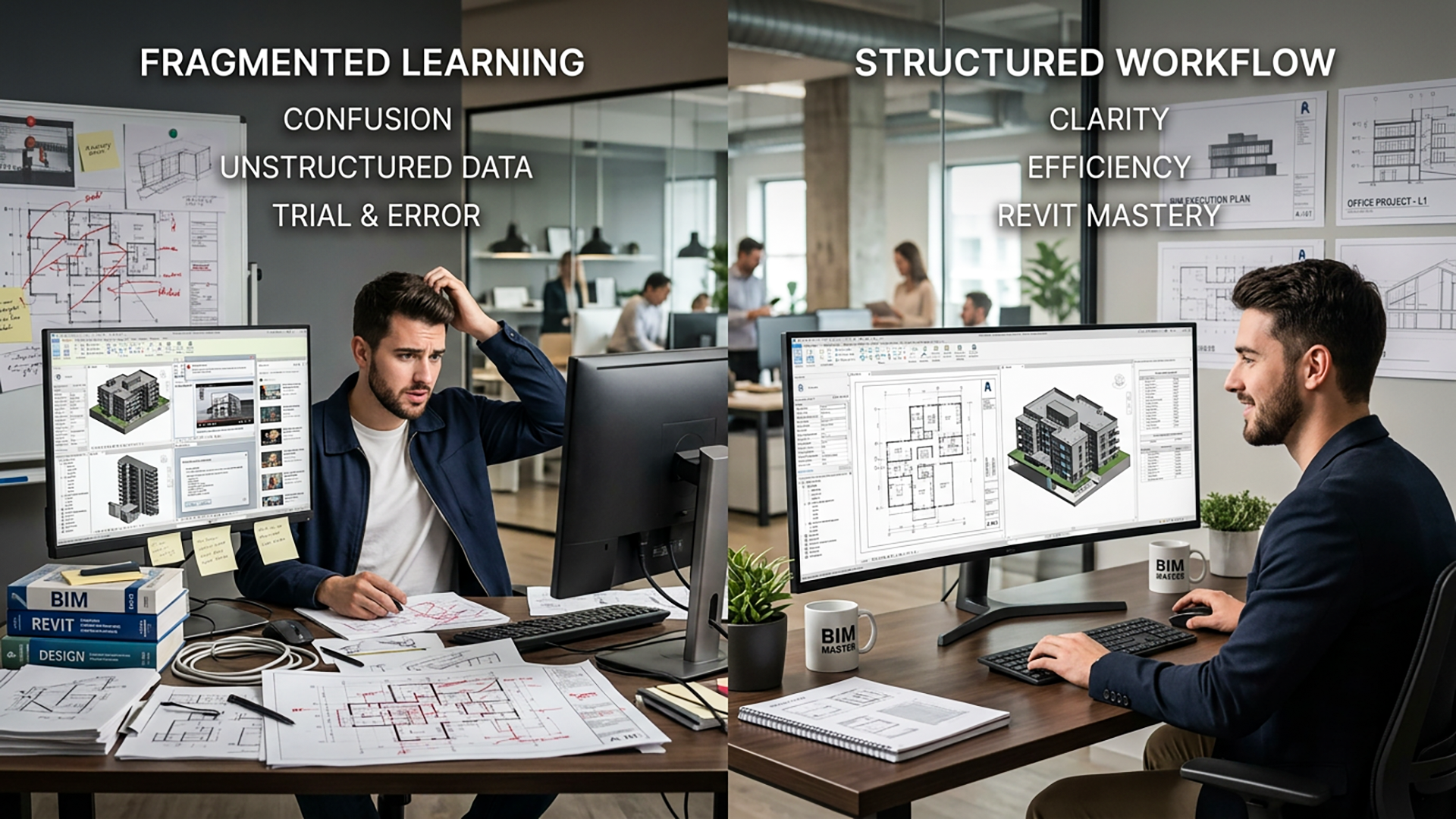
Stronger Revit learning should build more than tool familiarity.
It should help learners move from fragmented practice and trial-and-error into a clearer, more structured workflow that supports confidence, consistency, and better project outcomes.
What stronger Revit learning should actually build
Effective Revit training should build more than task completion.
It should help learners develop clarity, structure, judgment, transferability, and confidence.
That means helping people understand not only how to do something, but also what it is doing in the model, why it matters, when it should be used, and how it connects to the larger workflow.
This matters for beginners, but it also matters for intermediate users and for teams.
Because when the learning structure is weak, the consequences eventually show up in project work: inconsistency, slower troubleshooting, standards drift, documentation issues, and avoidable coordination problems.
In other words, weak learning design eventually becomes a workflow problem.
A better path is possible
The good news is that this can be improved.
When training is structured around understanding instead of overload, learners usually build confidence more steadily. They become better at predicting outcomes, better at connecting ideas, and better at transferring knowledge from one situation to another.
They stop depending so heavily on memorized steps and start developing real independence.
That shift is where stronger learning begins.

The transition to a workflow-centered approach. Once the conceptual structure is strong, the user is no longer searching for memorized clicks. They have deep clarity, can predict outcomes, and possess the judgment to navigate any new situation independently, transforming weak learning design into professional confidence.
If Revit learning has ever felt more confusing than it should, the problem may not be your effort.
It may be the structure of the learning itself.
And when the structure improves, confidence can improve with it.
If this perspective resonates with you, RSS Academy was built to support a clearer, more structured, and workflow-centered approach to learning Revit.
And if you have experienced this pattern in your own Revit learning journey, I would genuinely be glad to hear your perspective.
